

Documentation Index
Fetch the complete documentation index at: https://docs.fizenfoundation.com/llms.txt
Use this file to discover all available pages before exploring further.
THE MANIFESTO: THE END OF THE “TOKEN ILLUSION” AND THE DAWN OF REAL YIELD
The era of traditional “Utility Tokens” is officially over. For the past decade, the Web3 industry has been built on a dangerous economic illusion: The Greater Fool Theory. Millions of people flock to buy tokens not for their intrinsic value, but with a single, fragile hope: that they can sell them to someone else at a higher price. Without an underlying business model generating real external profits, this system is fundamentally a zero-sum game. That is why 99% of projects inevitably crash, leaving retail investors with massive losses. To mask this fatal flaw, most Web3 projects deploy a toxic growth strategy: selling the dream of “10x or 20x” returns to attract users. They launch massive airdrops and promise impossible cashback rates and rewards. But where does the money come from? The answer is simple: They print more tokens. Every reward users receive is actually being paid for by hyper-inflation (Token Emission) and the endless dilution of the ecosystem’s own value. This harsh reality does not only apply to small projects. Look at the infrastructure giants (Layer 1 / Layer 2) that were pumped with hundreds of millions of dollars by VC funds in the last cycle. The on-chain metrics do not lie:- zkSync raised $458 million but generates a mere $5,700 in weekly transaction fees.
- Linea raised $725 million but its network revenue hovers around ~$13,600/week.
- Highly anticipated projects like Celestia ($55M) and Sei ($35M) have disastrously low Daily Active Users (DAU) compared to their billion-dollar valuations.
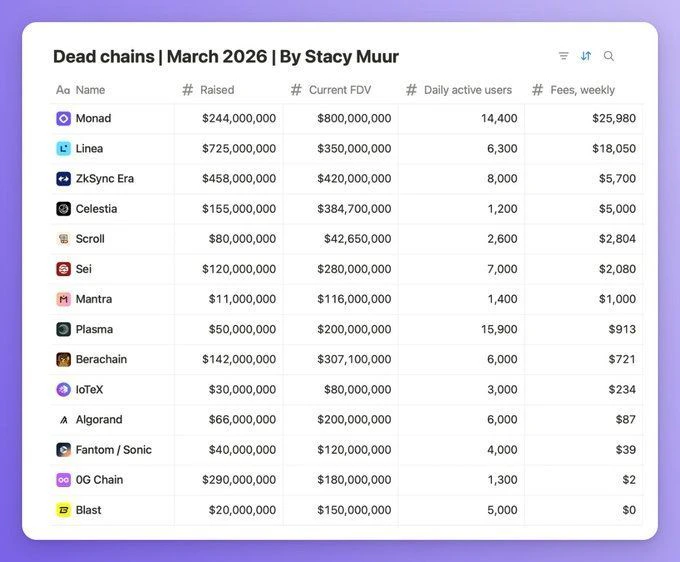
“Where does this project actually earn real profits?”If you cannot find the answer, then YOU are their source of profit.