

To ensure fair distribution, deep liquidity, and organic price discovery, $FIZEN will be launched through a carefully structured two-phase fundraising model: an exclusive Private Sale for Institutional VCs and an Uncapped Liquidity Bootstrapping Pool (LBP) Auction for the community. USDT raised from the Private Sale is allocated to provide liquidity for the Fair Launch Pool, which is subsequently transferred to DEX.Documentation Index
Fetch the complete documentation index at: https://docs.fizenfoundation.com/llms.txt
Use this file to discover all available pages before exploring further.
1. Core Tokenomics Allocation
Total Supply: 300,000,000 $FIZEN| Allocation Category | Percentage | Amount | Vesting Schedule |
|---|---|---|---|
| Private Sale | 26.67% | 80,000,000 | 6-month Linear Vesting |
| Fair Launch (LBP Auction) | 13.33% | 40,000,000 | Fully Unlocked (Day 0) |
| Liquidity (DEX Pool) | 13.33% | 40,000,000 | Injected into Liquidity Pools |
| Team & Founders | 5.00% | 15,000,000 | 12-month Linear Vesting |
| Ecosystem & Treasury | 41.67% | 125,000,000 | 24-month Linear Vesting |
Phase 1: Private Sale
- Selling Price: $0.0250 per $FIZEN.
- Target Raise: $2,000,000 (75% of this capital is injected into the Fair Launch pool, while the remainder funds operational and marketing activities for the Fair Launch.)
- Lock Mechanism (Vesting): All 80 million tokens allocated to VCs are strictly locked and linearly vested monthly over 6 months. Not a single VC token is permitted to circulate on exchanges during the Fair Launch, entirely eliminating early profit-taking pressure.
Phase 2: Uncapped LBP Auction (7-Day Fair Launch)
To ensure fair distribution and organic price discovery for the community, $FIZEN will debut via an Uncapped Liquidity Bootstrapping Pool (LBP) Auction. Uniquely, all tokens sold during the LBP are Fully Unlocked and enter circulation immediately.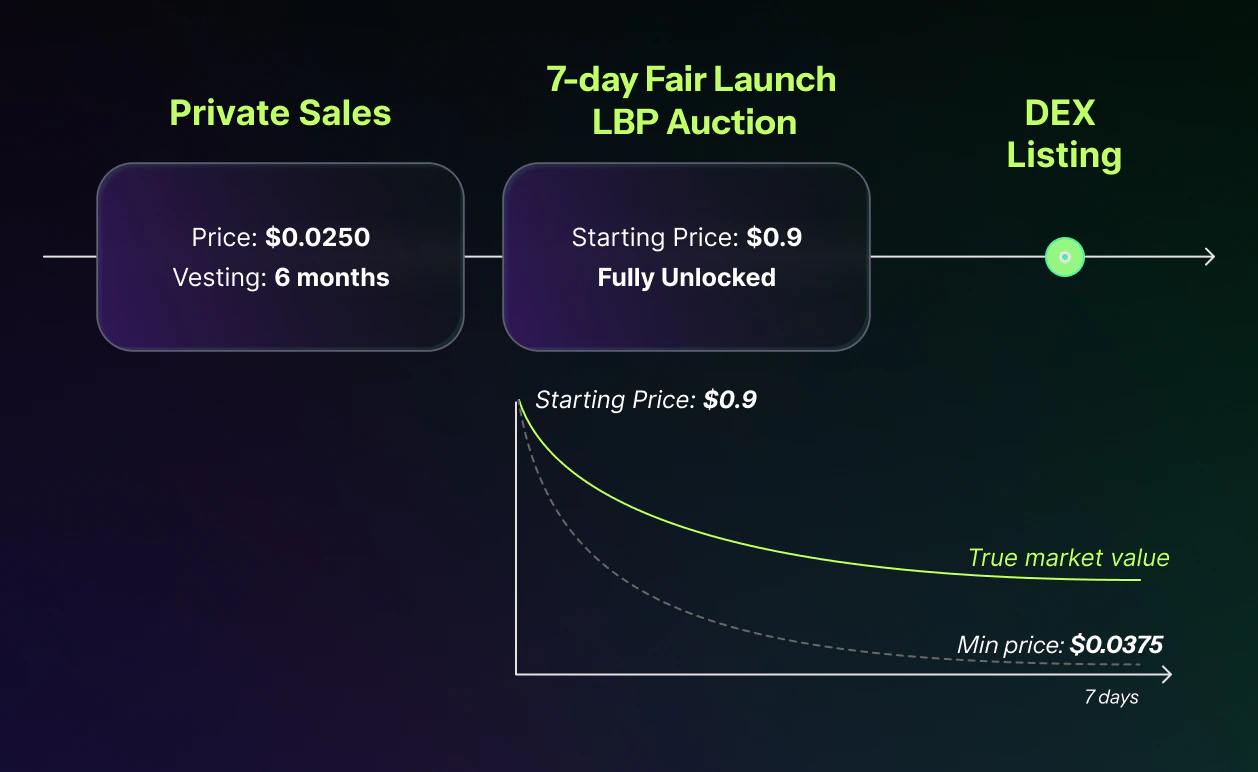
The Mathematical Weight-Shifting Mechanism
In standard Automated Market Makers (AMMs), a liquidity pool locks asset ratios at 50/50. However, an LBP is a specialized auction pool where the weight of the two assets dynamically shifts over time.- Sniper-Bot Prevention (The Starting Price): The auction lasts for 7 days. At Second 1, the pool ratio is intentionally skewed to 96% $FIZEN / 4% USDT. According to AMM math, this asymmetric weighting amplifies the Starting Price to a steep $0.9000 / 1 $FIZEN. The goal is to completely neutralize sniper bots and front-runners—who attempt to buy early at low prices and sell at higher prices for quick profit. Anyone buying at Second 1 will pay the peak price and face immediate losses.
- Decay Curve & Free Price Discovery: With every passing second over the 7 days, the Smart Contract automatically shifts this weight towards equilibrium (sliding from 96/4 down to 50/50). This shifting process naturally drags the price of $FIZEN downwards along a decay curve.
- Finding the Fair Market Value: During the fair launch, the price automatically slides down from $0.9000. Market participants continuously observe this decay curve. When the price drops to a reasonable level (e.g., $0.50), buying pressure will emerge. This buying action injects USDT into the pool, pushing the price back up, after which time drags it down again. This tug-of-war forces investors to organically discover the Fair Market Value dictated entirely by supply and demand.
2. VC Perspective (The Upside)
At an entry price of $0.0250, if the token reaches the LBP starting peak of $0.9000, the nominal ROI is an attractive 3600% (36x). Even if the LBP concludes at its mathematical baseline of $0.0375, the VC entry price still represents a highly appealing safety margin relative to the public launch, creating a strong buffer for risk-tolerant investment funds.3. VC vs Retail - The Strategic Balance
In the current Web3 landscape, many projects fail because retail investors have grown highly skeptical of VC-backed tokens, having been burned too often by early investors dumping at TGE. Consequently, the market increasingly gravitates toward pure “fair launch” models. However, the Fizen Foundation recognizes that VC participation remains crucial to secure initial seed capital, bootstrap the Fair Launch liquidity, and leverage institutional networks. To solve this friction—allowing VCs to participate profitably while fully appeasing retail—we have engineered a mechanism that transparently balances Risk and Return for both sides. By clearly defining the trade-offs VCs accept in exchange for their lower entry price (as shown below), we eliminate retail’s fear of being used as exit liquidity. This transparency builds massive retail trust, ensures strong community participation during the LBP, and ultimately protects the long-term value of the VCs’ investment:| Criterion | VC (Private Sale) | Retail (Fair Launch) |
|---|---|---|
| Entry Price | Lower | Fair Market Value (Discovered via LBP) |
| Initial Risk | Higher | Lower |
| Liquidity & Lockup | Locked heavily (Multi-month vesting). Cannot exit quickly. | 100% Unlocked at TGE. Can sell anytime if market shifts. |
| Price Risk | Bears the risk of price drops throughout the long vesting period. | Immediate liquidity to take profits or cut losses. |
| Utility Rewards | Few to no ecosystem rewards (Cashback) in the Super App. | Enjoys full Cashback, and Rewards privileges. |
4. Capital Flow & Post-Launch Execution: Strict Fund Segregation
To maintain absolute financial precision and transparency, Fizen strictly segregates the usage of funds raised during the Private Sale versus the Fair Launch (LBP). The capital does not go into the pockets of the Founders or the Team. It is allocated as follows:Private Sale Capital (The Bootstrap Fund)
The $2,000,000 raised from VCs acts as the essential seed capital to launch the token successfully and scale the brand.- 75% is injected directly as the initial liquidity pairing for the Fair Launch LBP.
- 25% is reserved for pre-launch operational expenses, global marketing, and Market Making (MM) provisions.
Fair Launch Proceeds (The Protocol’s Lifeblood):
The net stablecoin proceeds generated organically from the community LBP are strategically divided to balance long-term yield generation with immediate market defense and operational runway:- 75% - The Real Yield Treasury Engine: The core of the capital is strictly locked into the Fizen Foundation’s Treasury and deployed into yield-generating strategies (3e5.ai and Tokenized T-Bills) to power the continuous Buyback and Cashback reward flywheel.
- 25% - Protocol-Owned Liquidity (POL), Stabilization & Ops: This vital allocation is retained in stablecoins and tokens to provide deep DEX liquidity, fund professional Market Makers (MM), execute immediate price defense (Buywalls) during market panic/Black Swan events, and fund the ongoing operational expenses of the Foundation.
- Core Bucket (80%): Deployed into ultra-safe, low-risk strategies such as tokenized U.S. Treasury Bills (T-Bills), generating a benchmarked risk-free yield (e.g., 4% Annual Percentage Yield (APY), dynamically adjusting to macroeconomic rate cycles).
- Satellite Bucket (20%): Delegated to 3e5.ai for quantitative directional trading, targeting historical average returns of 120% APY.
- Total Blended Yield Target: (4% × 80%) + (120% × 20%) = 27.2% APY on the deployed treasury.
Transparent Yield Distribution & Buyback
Every month, accumulated yield is systematically withdrawn from the ERC-4626 vault. This transaction is entirely on-chain and publicly verifiable. The Fizen Foundation handles the Buyback and Burn of $FIZEN tokens directly from this generated yield. The profit allocation is structured as follows:- 90% User Rewards: Allocated to fund massive Cashback programs, staking rewards, and payment incentives for users.
- 10% Buyback & Burn: The Foundation systematically purchases $FIZEN from the open market and burns it permanently, creating long-term deflationary scarcity.
.jpg?fit=max&auto=format&n=7vvsX_ye6EQDpxuZ&q=85&s=8fddd65cf3780fc2c94999d16ff0217c)